Rebuilding a 10-Year-Old Custom Home Builder Website in WordPress — A Full Case Study
A decade-old website with a rigid grid layout, no content management system, and zero ability for the owner to update photos without developer help. That is what Benchmark Custom Homes in Winston-Salem, North Carolina was working with when Tammie reached out needing a WordPress website rebuild for her client. The brief was simple: rebuild from scratch in WordPress using Elementor, modernise the look, build a portfolio system the client could manage independently, and migrate the finished site to their GoDaddy hosting. This post covers how that project was delivered — and what ran alongside it.
The Client and the Problem
Who They Were
Benchmark Custom Homes is a high-end custom home building and renovation company based in Winston-Salem, North Carolina, founded in 1996 by Steve Frucht — a licensed professional engineer with an MBA from UNC Chapel Hill and over 25 years of construction experience. The business specialises in custom new builds, renovations and additions, and special projects across the greater Winston-Salem area. The website (benchmarkcustomhomes.net) had been running on the same grid-based framework for approximately ten years and needed a complete overhaul.
What Was Not Working
The existing website used a legacy grid-based system that was inflexible, difficult to update, and visually outdated compared to the quality of work the business was producing. Portfolio categories including Developments, For Sale, and Green Building were no longer relevant and needed to be removed. The client had no way to add or remove portfolio photos independently — every change required a developer. There was no modern navigation structure, no About page showcasing the team bios, and no FAQ or Testimonials sections. The site needed to be fully rebuilt rather than patched.
Tammie was clear about her preference: she liked the style of Standley Design and Build — a site I had previously built — and wanted something in that direction. Clean, professional, image-led, and easy to manage. This is exactly the type of project covered by my WordPress website design and development services at CodeSyte.
What I Proposed
Full WordPress Rebuild — $380 Fixed, 10 Days
After reviewing the existing site and receiving the revised navigation structure from the client, a complete rebuild was proposed using WordPress and Elementor Pro. The agreed scope covered a modern homepage with hero image and service sections, a tabbed portfolio system with categories (Custom Homes, Renovations and Additions, Special Projects, Kitchens, Baths, Outdoor Spaces), an About Us page with team bios and photos, Testimonials, FAQ, and a Contact page — all built for easy independent management. The delivery approach was to build on a private staging environment first, then migrate to the client's GoDaddy hosting once approved.
The staging-first approach is standard practice on all my WordPress development projects at CodeSyte. It protects the live domain during development and allows the client to review and approve before anything goes public.
The Build Process
Staging Build and First Draft
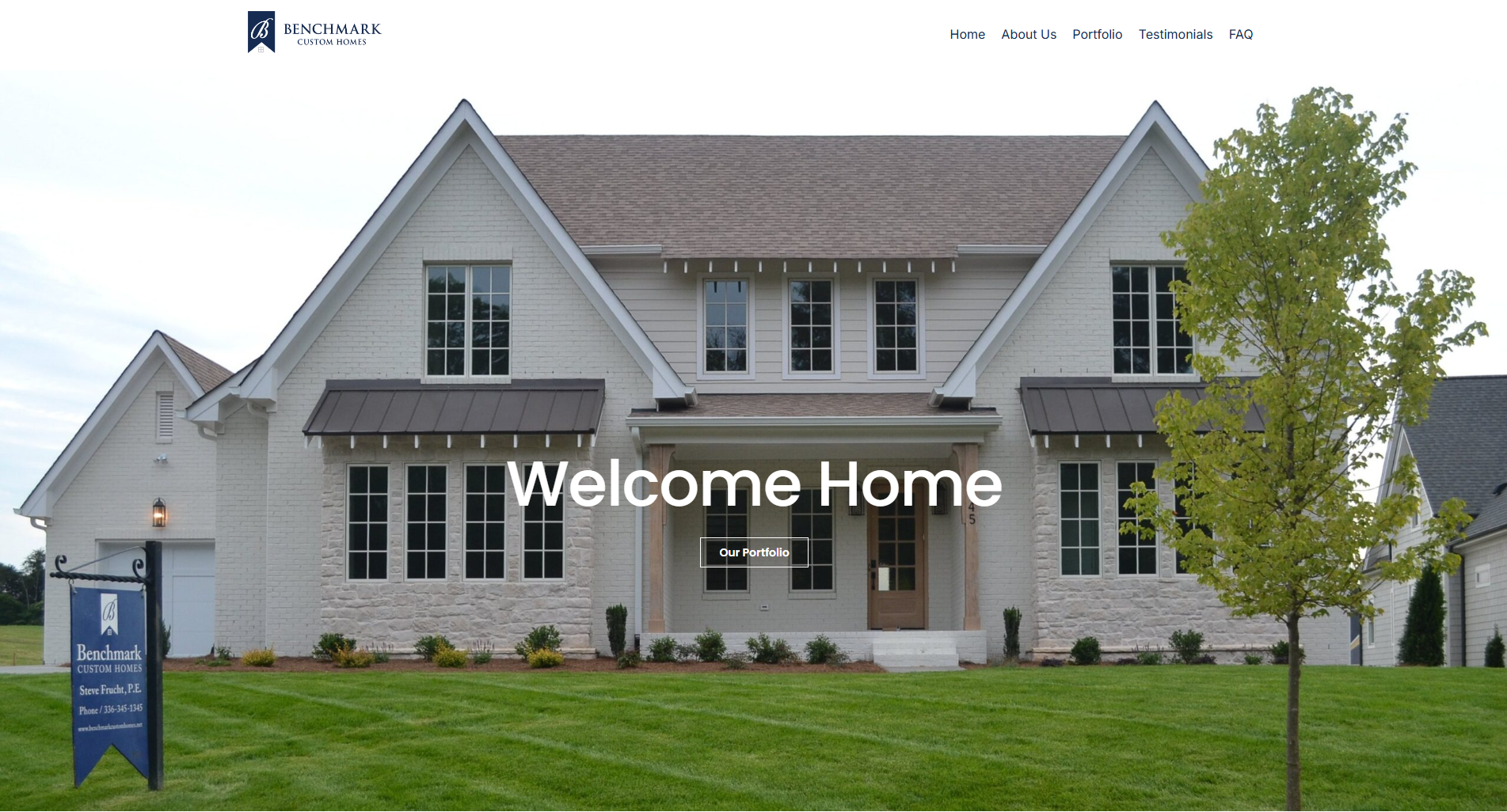
The first draft was delivered within five days on a private staging URL. The homepage was built with a hero section using the client's photography, a Welcome to Benchmark Custom Homes introduction section, a Services section featuring Custom Homes and Renovations and Additions with linked portfolio CTAs, and a social media footer. Elementor Pro was used throughout for full design control and client-editable content.
Portfolio System with Folder Management
The portfolio was built as a tabbed gallery system allowing the client to organise photos by category. A WordPress media folder plugin was installed so the client could upload images directly into categorised folders from the media library. A Loom video walkthrough was recorded explaining how to add a new category tab, create a gallery within it, and add or remove individual images — all without touching any code. Providing this kind of documentation is standard in every Elementor development project I deliver at CodeSyte.
Content and Photography Updates
Multiple rounds of content refinement were handled across the project. This included replacing all hero and section photography with client-supplied images, converting team and project photos to black and white for the Who We Are section, adding full team bios for Steve Frucht (President and Founder) and Mike Sloane (Superintendent) with professional headshots, implementing page-specific content sections rather than repeating the same blocks across all pages, and fixing all spelling errors flagged by the client including "Porfolio" corrected to "Portfolio" and "Contac Info" corrected to "Contact Info."
The before-and-after image overlay was removed on the hero section after the client identified an unintended blue tint — caused by a CSS overlay layer applied during initial setup. Removing the overlay restored the natural photograph quality the client wanted.
Navigation and Page Structure
The final navigation structure — Home, About Us, Portfolio, Testimonials, FAQ — was implemented with the Contact section moved to the footer only (no standalone Contact page), per the client's final preference. Each page was built as a self-contained section with no repeated blocks across pages. Testimonials appeared only on the Testimonials page. FAQ appeared only on the FAQ page. The homepage contained only the introduction and services sections — no portfolio grid, no repeated CTA blocks.
GoDaddy Migration and Go-Live
Once the client approved the staging build, the site was migrated to the client's GoDaddy hosting account at benchmarkcustomhomes.net. Domain propagation took approximately 24 hours. After migration, a sitemap plugin was confirmed active and an SEO plugin (free tier) was installed for basic on-page optimisation management. The client was advised on the basics of meta titles and descriptions for long-term SEO maintenance.
Second Project — Confidential Family Office Website
Running concurrently with the Benchmark Custom Homes build, Tammie commissioned a second project under NDA — a private WordPress website for a high-net-worth family office client. This project involved a public-facing informational site covering leadership bios, family philanthropy, and contact information, combined with a private family login section accessible only to authenticated users. The site was built on a custom sandbox domain, then migrated to the client's GoDaddy hosting at the correct domain. The public-facing pages were configured to be hidden from Google during development using a noindex setting, with the site visible only to logged-in users until the client confirmed readiness for public launch.
The family login system used WordPress user roles — Subscriber accounts for family members, Editor access for internal administrators — with a clean login page and redirect logic taking authenticated users directly to the private family section. This kind of role-based access control and private member area setup is part of my WordPress membership and custom development services at CodeSyte.
The Result
Benchmark Custom Homes — Live at benchmarkcustomhomes.net
The rebuilt site is live at benchmarkcustomhomes.net and running on WordPress with Elementor Pro. The portfolio system is fully self-managed — the client can add categories, create galleries, upload images, and remove outdated photos without any developer involvement. The team bios section showcases Steve Frucht and Mike Sloane with professional photography. Social media links connect to Instagram and Facebook. The site is fully mobile responsive across all pages.
Client feedback after the first draft: "This is a terrific start." After delivery: "Client is very pleased." The project continued into additional revision rounds as the end client provided further feedback — all handled within the agreed scope. A mobile navigation fix on a related WordPress site (twincityfoundation.org) was resolved as a courtesy during the same engagement — identified, diagnosed, and fixed within minutes.
Ongoing Relationship
Tammie became a long-term client with multiple active projects running simultaneously. Phase 2 of the family office website — covering additional section builds, expanded leadership pages, and a broader content structure — was in planning at the close of Phase 1. She also confirmed a third upcoming project at the end of the engagement. This pattern of ongoing work from a single well-managed initial project is what I aim for on every engagement at CodeSyte.
Key Takeaway for Construction and Home Builder Websites
Portfolio Systems Need to Be Client-Manageable From Day One
A custom home builder's website lives or dies by its portfolio. The photography is the proof of quality — it is what convinces a prospective client to make an enquiry rather than clicking away. If the portfolio cannot be updated easily as new projects are completed, it goes stale. Building the portfolio system with a clear folder structure, a documented management process, and a video walkthrough means the client can add new work immediately after a project completes — without waiting for a developer. This is the correct approach to any portfolio-driven WordPress build.
Staging Builds Save Time and Prevent Mistakes
Building on a private staging environment rather than directly on the live domain allowed multiple rounds of content, photography, and structural changes to be made without any public visibility during development. When the client was ready to go live, the migration was a single clean operation. No broken pages, no half-finished sections visible to prospective clients, no GoDaddy DNS issues affecting an active site. Staging-first is not optional on a project with a real client and live business — it is the professional standard.
Multiple Concurrent Projects Require Clear Scope Separation
Managing Benchmark Custom Homes and the family office website simultaneously — with different clients, different briefs, different confidentiality requirements, and different technical approaches — required keeping scope, feedback, and billing completely separate for each project. Clear communication, documented revision rounds, and separate invoicing for each phase kept both projects moving without confusion. This is the operational discipline that makes multi-project client relationships work over the long term.
Final Thoughts
The Benchmark Custom Homes project is a straightforward example of what a professional WordPress rebuild looks like for a construction and home building business: staging-first development, client-manageable portfolio, clean navigation, proper photography integration, and a smooth GoDaddy migration. The concurrent NDA project demonstrates the same technical rigour applied to a sensitive, high-privacy client context.
If you run a construction, renovation, or home building business and need a WordPress website that showcases your portfolio properly and lets you manage it independently — or if you have a sensitive project requiring a private staging environment and role-based access control — that is exactly what I build at CodeSyte. Explore my full WordPress development, Elementor, and portfolio website services here, or get in touch directly for a review of your current site.